Wednesday, October 24, 2012

ClownInPathos

Recently I came across an interesting blog that caught my attention. The blog name is ClownInPathos. While the blog is not scholastically or professionally written, the blogger focuses on expressing her thoughts and problems that she encountered in her life as a Chinese-American. Lan Lin is a 24 year old woman raised in United States with Asian parents, and she offers deep insights into the clash of the two cultures and the misery of being brought up in a Chinese household with strict child-rearing styles. Similar to my blogs as I address the issues in Asian households from my perspective as a child who have experienced both cultures, Lan Lin also voices her frustrations and problems of Asian parenting that are so evident in Asian American families, yet often times ignored. She believes that by openly blogging, she is stepping up and making the issue apparent despite how Asians are taught to ignore these problems. Her intended purpose to blog is to have a platform where she can share her lessons as a child who suffered from lack of good parenting to other unhappy Chinese American kids growing up. Lan would like to share her thoughts on the things that should be avoided “to raise a well-adjusted adult.” For this reason, she blogs consistently on an average of 4 times a month through livejournal, which is ranked 118 on alexa. 


Even though Lan Lin started the blog to address the issues of Chinese parenting, many of her posts are merely her frustrations, and thoughts as a child torwards her own parents. She shares her personal experience through her story telling and engages the audience with actual happenings in her life as a child in a Chinese household. Similar to my blogs, I also share my experience and thoughts on Chinese parenting though my personal experience. However, while I am still confused and still figuring out the dilemma of being a Chinese who have encountered American values and explaining the clashes I have witnessed, Lan Lin takes a strong stand in her posts and voices her thoughts extremely as she takes on a side against Chinese parenting and believes that her parents have caused her depression and were unsuccessful in raising her.


For example, one of her posts “ My Mom’s Reaction” talks about the first time she letting her mom know about her depression and how unhappy she was due to her mother’s tough, pessimistic child rearing. This was something that I have never thought about, confronting my mom about the clash in values and culture back at home and at school. The reason why I haven’t is because I was afraid of getting the same answers that Lan Lin’s mom gave her. “You’re scary, don’t think of these things.” I was scared that my mom would look at me differently, and think that I am not grateful for the things she has provided for me and will look at this discussion on the clash of values as more of an argument initiator (which I will want to avoid).  Also, my mom might think that I am being rebellious because in Asia, we are taught to keep our mouth shut and power through. But like Lan says, “[my mom] never actually saw me unhappy,” because when I was around her I was too busy being a role model she wanted me to be. At the end of Lan’s talk, her mom didn’t believe what she was saying, claiming, “Lan seemed fine growing up, I never saw [Lan] unhappy, I remember times when [Lan] were doing pretty good, [Lan] did so well in school.” Once again, we see the emphasis on academic excellence and how doing well in school was equivalent to the overall well-being of a child. However, for Lan, she got what was on her mind off her chests, which was the difficulty of growing up. She didn’t talk to her mom for her mom, but for herself, and that is an action that I wish I have the courage to do one day: to be upfront with my mother.


Similar to my work, she also lists the different values evident in the two cultures as seen in the post “American Ideals vs. AsianTrauma”. While one of my previous blog posts (whoever remembers gets a prize!) focused primarily on the optimism of Americans and pessimisms of Asians, Lan went beyond those values and explored other concepts including “saving faces, ma fan, and nans”. Ma fan, which means troublesome, and nans, which means difficulties, are all concepts that I think many Asians can relate to. “Don’t bother other people too much if you can, and overcome difficulties in your life” was often what Asian kids like me were brought up to believe. However, I want to talk about saving face, a phrase and concept that is very unfamiliar to Westerners. In Asia, parents take great pride in the family, and that pride is called face in Asia. If the kids, or someone in the family, fail in being successful or in accomplishing something, the family loses its pride, and thus, face. For this reason, every Asian parent wants to have lots of face so they continue to push their kids to earn face in the household. This is also the primary reason that Lan says why Asians are so negative because “they are afraid to lose face, so they don’t try anything that’s ma fan and nans.” Also, this explains why Asian parents are so strict with their children and expects them to succeed in school.

While Lan’s insight into Chinese parenting was detailed, she was also very biased in terms of her viewpoints. In her own words, “everything positive about me, I associate with the American culture. Everything negative about me, I associate with the Chinese culture.” Because of this bias thought, sometimes her examples can be extreme, so definitely be wary of that. That’s also why on my blogs you will never see me expressing any favoritism towards different parenting styles, because I want to be fair to both sides and I don’t think Chinese parenting has caused me to be miserable in life. On the contrary, even though I complain on some aspects of Chinese parenting, I think Chinese parenting has done me good (I am a happy Trojan). However, blogs like Lan’s will help me understand each side a little better and help me gain a better understanding of Chinese parenting and be able to compare my experience to hers.

Thursday, October 18, 2012

My Bookmarking Soulmate


Through the social media-networking site Del.icio.us, I was able to find my “bookmarking soul mate”: Flogus. Similar to my blog topics on Chinese parenting, specifically on the relationship between Tiger Moms and their children, Flogus bookmark topics on Chinese parenting and Amy Chua extensively. Flogus has roughly bookmarked 30 links overall and bookmarks on an average of 5 times every month. Furthermore, the articles are not specifically categorized under tags since the articles regarding Tiger Mothers or Chinese parenting are all categorized either under the tag name “parenting” or “Chua”. Even though Flogus does not thoroughly bookmark and add relevant tags or comments, all the tagged articles are very useful articles that cover a broad range of information on the topic of Chinese parenting. Some articles are based on reactions to the book or Amy Chua’s parenting style; others are on whether or not Chinese parenting style is superior to American style. Lastly, the discussion of child rearing is also covered in his bookmarked pages.

Through Flogus link, the two sites that I found very interesting are “Why this Chinese Mother Chose to Evolve” and “Why AmericanMothers are Superior.” Both articles provide different insights on child-rearing and different perspectives on parenting styles that further discusse the topics touched upon by Amy Chua in the book Battle Hymn of the Tiger Mother.

One of Flogus’ bookmarks caught my eye immediately, it was “Why this Chinese Mother Chose to Evolve” by Patty Chang. Before reading the article, I was excited because I thought this article must be about the shift in Chinese parenting towards a more liberal one. As a hybrid child, who went to an international school but raised in Taiwan, I thought this article must pertained to me. However, after reading the article, I was dumbfounded because Patty went beyond explaining simple parenting styles and into the specific values in parenting, more importantly, how those values are subjective.

In the article, Patty talked about her experience growing up under strict Chinese parenting, and how she feared of failing. Her parents were always pushing her to be # 1 so she can be successful. Now 30, Patty went through an Ivy League school and works at a high profiled media company making lots of money. In everyway, she has accomplished what her parents wanted. Nobody can argue her success, or can they?

She pointed out despite all the success, she would wake up in the middle of the night with fingernail imprints on her clenched palms and her inability to get pregnant. She felt like a failure. Then, she adopted a child, G, that changed her outlooks.

Despite Patty trying to work G, G just wasn’t good at academics, and her turrets syndrome didn't help. She hates reading, but loves sports. She can’t do math, but excels in creative writing. More importantly, she is happy and full of energy. For Patty, she sees more success in G than she sees in herself. If the tough love of Chinese parenting is based off deep love, then the parents shouldn’t compare their children, but rather, foster a unique relationship that allow them to do what they want to do. Success is very subjective, and for the reason, Patty decides to evolve her definition of success for G, out of deep, true, love.

This article is so interesting to me because it didn’t only state that parenting needs to evolve, but why. At the end of the day, all the parents want the best for their child, but what is best? This article takes the readers into a different path and evaluates parenting styles through the definition of success.

Another article that grabbed my attention was “Why AmericanMothers are Superior” by Annmaria De Mars. The title itself made it apparent for me that it must be a response to Amy Chua’s article. I was excited to see what Annmaria has to say, especially because she boldly states that American mothers are superior and it’s a direct opposition to Chua’s article “WhyChinese Mothers are Superior.” In this article, Annmaria practically said that she is the same person as Amy Chua with very different parenting styles. Amy Chua is a professor at Yale, and Annmaria is a P.H.D. who won several awards. Annmaria attacked the fact that Amy Chua doesn’t have the credentials to boast because all her kids haven’t even made it out of school (one in college and one in high school). Annmaria, however, has three children that have all graduated and are doing really well in life. One is an award-winning journalist, one is a teacher teaching inner-city children, and the last one is an Olympian medalists. Annmaria took a very interesting approach and challenged Chua by comparing her children to Chua’s and made the opposing argument, which shows the American side of the story. Her perspective as an American parent deepens our understanding on the two different cultures of parenting.

These two articles are what I found most interesting; go check out the other articles Flogus has bookmarked to learn more about Tiger Moms and share which ones stood out for you! 

Thursday, October 4, 2012

A Hybrid Tiger?


Yale? Still not good enough for Tiger Moms evidently. We all know education is highly valued by Chinese moms, aka, Tiger Moms. This is not something new. Tiger Mom’s emphasis on education and academic success is why we have the stereotypes of Asians being good at math or Asians being smart. But are Asians genetically just smarter or like to study? I don’t think so! (I definitely do not like to study) Even though education is highly emphasized in Asian households, it is important to note that it is not the learning process that is important to Tiger Moms, but the results that matter. It is purely the belief that academic success will lead to future life success such as getting a good job. And of course, the definition of a good job is simply a high paying one. We all know success does not mean a high degree in school, look at Bill Gates and Steve Jobs! Nevertheless, one of the most prominent features of Tiger Moms is their requirement of a GPA of 4.0. So ultimately, what matters is not the learning, but the grades. For this reason, a lot of Chinese children are taught to memorize equations, formulas, rather than truly understand how to get those results.

Similarly, my Tiger Mom is the same. She did not care what I was learning in school or whether or not I learned anything, as long as the final results at the end of the semester was an A on the report card. As I mentioned in earlier blogs, the demand for success is due to the traditional expectation that children will support their parents when they grow old. This is an important Confucius value “xiao” that is greatly emphasized and also is in relationship of filial piety.

On the other hand, do Western parents really not care about education? It is said that both Asian parents and Western parents want the best for their children, but the definition of best differs. For Asian parents, it is for their children to have a successful career and make as much money as possible in order to give back to the family. On the other hand, Western parents are said to emphasize more on happiness and children are allowed to explore their own passions. Research has shown that this differentiation is often times due to cultural differences. However, as the world becomes more international and global, we have immigrants in America such as Amy Chua who are still practicing the strict Chinese child- rearing way. Is this passing on of culture going to continue and will Tiger Moms still exist?

Children of second generation in United States, or in my example, being able to attend an international school, picking up ideas from the Western environment that stresses the importance of exploring your passion, doing what you love, may slowly assimilate ourselves into the Western culture. With the publish of the book, there are many responses from both the Western and Eastern side on whether or not Chinese parenting is superior. Interestingly, there is no consensus, as some Westerners believe it is superior while some Asians go firmly against it. There is no clear distinction between the two ethnicities and their thoughts on Chinese parenting, so is culture really what differentiates the two parenting styles? After the publication of the book, more conversations have taken place regarding some practices in Chinese parenting that are seen as "immoral". Will there be the perfect way of parenting or will there be a middle ground as both sides of the parents reflect on their styles? Will second generation kids who have Tiger Moms become one themselves after complaining on the strict rearing methods they’ve been through themselves? Maybe a hybrid parenting style?

What do you think?

Wednesday, September 26, 2012

Roaring Tigers


This video went viral and had over 5 million views in just one week. It was concise, funny, and to the point. Yet in some weird, twisted way, while obviously exaggerated, this video revealed some truth regarding Asian moms and stereotypes. The video itself was very simple. It had one Asian male dressed up as an Asian mother and lashing out ridiculous sayings and things to their kids.

Although this video is a little bit exaggerated, I believe that it is still reflective of Asian moms, aka tiger moms. Sure, my mom did not yell “B is for bitch” when I came home with a B on my report card; nevertheless, she would be disappointed in me and as punishment, she would take away my privileges like watching TV, surfing the net, or going out until I pull my grades up.

Ever since first grade, I had to attend multiple after school tutor sessions. My mom was always afraid that I would be behind in school. You may wonder, what is so difficult in first grade that a tutor is necessary? Tutoring sessions did not only cover materials taught in class, it was also about “previewing” materials, planning for the future, covering materials in second grade. In my mom’s mind, being prepared ahead of time is always for the best.

On top of homework from school, cram schools also assigned homework and tests. I remember attending a math institution with my neighbor. One day at home, I heard my mom yell my name. I immediately recognized the anger in her roar. She was mad. I am in deep trouble I thought to myself. What did I do wrong this time? I reflected on the day and could not think of what I did wrong as I quickly hustled in my room to see my mom holding a test paper she found in my backpack.

“What kind of grade is this?!” She yelled as she pointed on the 82% on the paper.

I remained silent, as I don’t recall getting this grade. Then, I remembered I picked up my neighbor’s test for her since she was sick and wasn’t able to attend class.

“Mom, it’s not my test.” I answered, as I felt relieved.

Instantly, similar to the video when the Asian mom picked up the phone and had a change of tone immediately, my tiger mom smiled and said nothing more.

Another point that the video brought up that I have personally experienced is that Asian moms are constantly comparing their children. My mom always compared me with other children who did better in school. She would praise them and scorn me for not being good enough. However, this is not a fair game. Since if I ever complained about anything in the household, my mom would tell me to “go join other family.” That was her ultimate line to anything I said, whether or not I made sense or not, tiger moms are always right. Even if I reasoned with her, instead of admitting fault, she would simply ask me to be someone else’s children. By then, there was no come back that I could think of to retaliate.  

She wins again.

Most people will watch the video, laugh at how ridiculous the heavy accent is and the statements she makes. To them, those are the key points. But for me, it is nice to know that I am not alone after all!


Thursday, September 20, 2012

Training = Spanking


So besides the basic requirements such as sending their children to learn how to play instruments, pressuring their children to get only A’s in school, and asserting the “do as I say” attitude, what else are there about Tiger Moms?

Aside from all the well-known and infamous qualities of an Asian mom, I am here to reveal the other secrets of the tiger mom that you never know about. Mentioned in previous posts, Tiger Moms believe that they know 'best' from their experiences, and based on their knowledge they have gained in life, they are setting their children up for the best future possible. They are doing this for the children’s good, and they should not question but rather be thankful. Do Western parents not care for their kids then?

Personally, I think the main difference between Western parenting and Chinese parenting is that Chinese parenting is based on fear while Western parenting is based on rewards. For Chinese parents, it is acceptable to hit their children if they did something wrong or didn’t achieve the expectations. However, as the society becomes more aware of domestic violence and individual rights and freedom, Chinese parents no longer spank their children like they did before in order to not get in trouble with the law.


Unluckily, I did experience the spanking era. Amazingly enough, as the Westerners will soon find out, the spanking was not only at home, but also in schools. Before attending the International School, I went to a private local school in Taiwan. Ever since first grade, spanking was already a common way to “tame” the youngsters. So when exactly did the teachers spank the students? From being late, to showing a slight attitude, to even wanting to use the restroom too often. Pretty much whenever the teacher felt was appropriate and necessary!

You may wonder, are parents against this? You may be surprised to find out that parents are actually all for this. Parents often ask the teachers to be stricter and spank their children. Chinese parents believe that the teachers are “disciplining” their children for them so that they would be more obedient in schools and homes. Teachers would spank students when they are loud in class, talk without permission, and most importantly, when students get a lower grade than a 90%.

The rule was, one percent lower than 90% was equivalent to 1 spank on the hand. Forgot your textbook? That means another spank on the hand, sometimes even worthy of two hits! I still remember in first grade when tests were returned, every student with a grade lower than 90% had to stand in front of the class in a line with their palms facing up as the teacher spanks each student with a ruler or sometimes worse, a wooden stick. Besides these, parents and teachers would utilize other tools as well to spank such as hangers, kitchen utensils, even with a belt. In American universities, students try to find out which professors are more fun, give out less homework, or make easier exams. But in my elementary school, teachers were known for how strict they are and how often they use physical punishments, or even what tools they used.

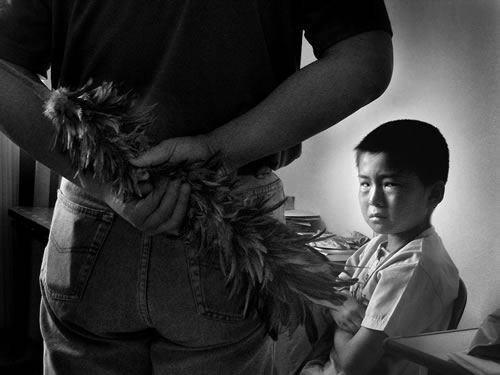
The pain does not end in school. Back at home, parents also use fear as the means to “training” their children. What are some common ways Chinese parents utilize besides spanking? Think locking you in a dark room, or outside on the balcony. Sometimes it may just be facing the wall for an hour standing, as it is a time of reflection on what you did wrong. I remember when I was young I was always scared to do something wrong, because that meant pain and punishments! However, I was also rewarded if I did well in school. I remember when I first learned the alphabetical order my mom would be holding a hanger and spanking me whenever I got an alphabet wrong. Only when I finally got everything correct, I was rewarded with a trip to McDonalds.

On the other hand, Westerners use reward as encouragement for what their children have done right. If they do well in school, they will receive rewards. If they didn’t do well in school, parents were encouraging and would try to find ways to help. I still remember when I first transferred to Taipei American School, I was so happy that there was no physical punishment and you were rewarded for everything that you do right. “Life was so easy and free,” I thought to myself.

Are you surprised to hear about how rough Chinese parenting styles are? Coming in from a background of Chinese and American education, I am now more aware of the different educational styles and can fairly assess both styles. While it is not my job to say which system is better and more productive, it is my job as a cub to reveal the secrets behind the Tiger Moms.

Wednesday, September 12, 2012

Tiger Mom's Parenting

So what do others have to say about tiger moms? Initially, I attempted to find scholarly journals with the key word “tiger mom”, but the results were scarce and the articles were very basic as they merely defined the phenomena without providing much explanation. In fact, most of the articles were referring to the animal.

Then I focused my research on Chinese parenting, a topic that offered more refined searches. After reading a few articles, I noticed that many sources relate parenting to socialization and explore the relationship between different parenting styles. The journals were mostly studies related to family relations.

One article that made a strong impression on me is the research done by DePaul and Duke University professors called "Maternal Socialization Goals, Parenting Styles, and Social-Emotional Adjustment Among Chinese and European American Young Adults: Testing a Mediation Model." Their research compared the relationship between parenting and socialization goals. Socialization, according to Li, Costanzo, and Putallaz, involves the process for young adults and kids to learn from others at the early days of life, providing individuals the skills and habits they require to survive in society. Socialization goals, moreover, describes the end result of socialization which is the moral outcomes after individuals have learned at a young age.

Furthermore, the paper focuses on socialization goals that are important both to Chinese and European Americans and similarities and differences were examined. The obvious difference between Chinese and European Americans is their socialization goals. Research has shown that European American mothers emphasize self development goals more vigorously than do Chinese mothers while Chinese mothers place a greater emphasis on developing the value of filial piety in their children. The other two sources I found also address the role parenting plays in the socialization of children and further explore how Chinese parenting often leads to certain values that may differ from those developed by Western parenting. These values, I argue, allowed the creation of “tiger moms.”

One value, filial piety, became a prominent theme throughout my initial research. Filial piety, defined in the article as respecting elderly and the sense of responsibility for taking care of your elders as well as obeying them, is mentioned as one of the primary reason for the differences in Western versus Chinese parenting in many families today.


Speaking from personal experience, filial piety is a value that was instilled in me very early on. I was expected to follow my mom’s words because the elders always know best. If I follow what they say, I will have a bright future. The important thing is, the bright future is not only for me, it is for them as well. Besides respecting the elders, taking care of your parents when they grow old is also a big part of filial piety. Here’s what a conversation with my mom would sound like.

“Why are grades so important? They don’t necessary reflect how much I learn in school,” I questioned.

“How else are you going to make a lot of money?”

“I don’t need to make a lot of money to be happy though,” I answered.

“But you need to make a lot of money for me, because I want to move into a penthouse.”

Maybe you are asking why I need to fulfill my mom’s wishes? This is because of the Chinese belief that children own it to their parents for fostering and nurturing them. In return, it is the children’s responsibility to repay their parents when they grow old. On the other hand, in the Western culture, parents believe that it is their responsibility to take care of their children until legal age, then their responsibility is done. They do not ask for anything in return. This may also be one of the reasons why Western parents are more open to what their children want.

Perhaps it is the idea of always obeying one's elders that gives the mom the mindset to rear their child any way possible. By exploring these values more deeply, I believe that I will be able to understand the creation of tiger moms and better understand the dilemma.

Hear the Tiger Kid Roar


Is your mom a tiger mom too? Battle Hymn of the Tiger Mom is a book by Amy Chua published in 2011 that became a hotly debated topic among individuals. The book coined and popularized the word “tiger mom” and now it is widely used to describe Asian moms.

So what exactly are Asian moms like? Or what describes a tiger mom? A tiger mom now portrays moms who practice strict child rearing, which most commonly refers to Asian moms who practice traditional parenting. In my definition, traditional parenting is when parents set extreme boundaries for their children and restricts them from many activities such as sleepovers or other social activities that they believe may hinder academics. It also means setting high objectives for their children such as getting into Harvard for college.

Now, I certainly can relate to the word “tiger mom”. The descriptions of a tiger mom fits my mom’s characteristics; it is then when I realized I am not alone. My mom is indeed a typical Asian parent who expects the best out of me. Like Amy Chua’s children, I was put in a Western education system, which is the trigger of the arising conflicts between a tiger mom and a “hybrid” kid.

I was born and raised in Taipei, Taiwan. However, I attended an international school called Taipei American School since 5th grade. The school is an American based institution that emphasizes on Western values and strives to educate students to become creative thinkers, healthy individuals, and versatile learners. The conflict now arises since back at home I have a mom who preaches on traditional Chinese values and exemplifies all the qualities of a tiger mom. While in school I am encouraged to explore my talents and build on my individuality, my mother already has everything planned out for me in terms of what will be best for my future. Like all other tiger moms, my mom expects me to work hard and do well in school, which means getting straight A’s. On the other hand, the school preaches on the importance of extracurricular activities and development of your hobby. What should I do? Should I go home to study so I can achieve the highest GPA possible or should I stay in school to join a club and enrich myself through activities?

Why put your kids in an American based institution if you still want to exercise traditional parenting is often the question I have towards my mom. However, of course, I never had the chance to speak up to her since that would be considered disrespectful and rude. My mom believes that the Western education is better than the Chinese education and by studying in the United States, it will ensure a better future. How ironic! The reason to put me in a Western institution is based on a tiger mom’s hope to pave the path to success for her children.

What’s more ironic is my mom believes that the Western education system is superior because it encourages creativity and open mindedness. Western education focuses on making individuals and students express their concerns and ideas openly with their teachers. However, in the Eastern education system, the teacher is the knowledge provider and the authority; thus, the teacher should not be questioned. By putting me through the western education system, she would like me to explore my talent and develop myself; however, she was against the idea of me majoring in fine arts. Like any other tiger moms, she believes that being a business major guarantees a more stable future than that of fine arts major. Once again, on one hand, my tiger mom wants me to learn from the Western education system and develop my interest and learn to have a voice and personality; on the other hand, she’s infringing on my development by making life decisions for me. Now I am confused.

Exploring on what a tiger mom is like and looking at tiger moms through personal experience, I would like to share my experience as the kid who has been through it all. Not only am I relating with those like me, but also it is to speak up to the tiger moms out there since I’m sure the cubs never had the chance to! So listen up, it is time to hear a cub roar.